


- Why Your First Deck Matters
- The Rider-Waite-Smith: The Classic Starting Point
- What to Look for in Your First Deck
- Popular Beginner-Friendly Decks
- The Myth About Receiving Your First Deck
- Where to Buy Your Tarot Deck
- Caring for Your New Deck
- What to Do Once Your Deck Arrives
- Trusting the Process
- Frequently Asked Questions
Have you been feeling the pull to pick up your very first tarot deck? Maybe you’ve watched a friend lay out cards with quiet confidence, or perhaps you’ve been drawn to the mysterious imagery every time you walk past them in a shop. Whatever has brought you here, I want you to know — this is one of the most beautiful steps you can take on your spiritual journey.
After more than four decades of reading tarot and guiding thousands of souls, I can tell you that choosing your first deck is truly a sacred moment. It’s the beginning of a conversation between you and the divine, one that will deepen your intuition, illuminate hidden truths, and offer guidance when you need it most. But with hundreds of decks available today, how do you know which one is right for you?
Don’t worry, dear one. I’ve helped countless people navigate this very decision, and I’m going to share everything I’ve learned so you can find the perfect deck to begin your tarot journey.
Why Your First Deck Matters
Your first tarot deck is more than just a set of cards — it becomes a trusted companion on your spiritual path. Think of it as choosing a teacher. The right one will make complex concepts feel accessible, while the wrong one might leave you feeling confused and disconnected.
The deck you choose sets the foundation for how you learn to read the cards. When the imagery resonates with you on a deep, intuitive level, your readings will flow more naturally. You’ll find yourself understanding card meanings not through memorisation, but through genuine connection with the symbols and stories each card tells.
Your first tarot deck should feel like coming home. If you pick up a deck and feel a warm pull in your heart, that’s your intuition telling you this is the one.
I still remember my very first deck. It was the late 1970s, and I held those cards in my hands and felt something shift inside me — like a door had opened to a room I’d always known was there but had never entered. That feeling of recognition is what you’re looking for.
The Rider-Waite-Smith: The Classic Starting Point
If there’s one deck I recommend more than any other for beginners, it’s the Rider-Waite-Smith (often simply called the Rider-Waite or RWS). Created in 1909 by Arthur Edward Waite with illustrations by Pamela Colman Smith, this deck has stood the test of time for good reason.
What makes the Rider-Waite-Smith so special for new readers is that every single card — including the Minor Arcana — features full scenic illustrations. This means you don’t need to memorise meanings right away. Instead, you can look at the imagery on each card and let the story it tells guide your intuition. The Three of Swords, for example, shows three swords piercing a heart beneath storm clouds. Even without any tarot knowledge, you can feel the heartache in that image.
The vast majority of tarot learning resources are based on the Rider-Waite-Smith system, which means you’ll have access to an enormous wealth of books, courses, and online guides that reference this deck specifically. As you deepen your practice, you can always branch out to other decks, but having a solid RWS foundation makes learning any new deck infinitely easier.
What to Look for in Your First Deck
Imagery That Speaks to You
The most important factor in choosing your deck is how the artwork makes you feel. Tarot is fundamentally an intuitive practice, and your readings will only be as strong as your connection with the cards. Spend time looking at sample images online before you buy. Do the characters feel alive to you? Can you imagine telling stories from the pictures? Do certain cards make you pause and think? These are all wonderful signs.
Some people are drawn to the golden, traditional imagery of classical decks, while others connect more deeply with modern, inclusive illustrations. Neither preference is better or worse — what matters is that the deck speaks to your soul.
A Complete 78-Card Deck
For your first deck, I strongly recommend choosing a standard 78-card tarot deck. This includes 22 Major Arcana cards (the big life themes) and 56 Minor Arcana cards (the everyday guidance). Some specialty decks have fewer or more cards, and while those can be lovely additions to your collection later, a full 78-card deck gives you the complete tarot system to learn from.
Be careful not to confuse tarot decks with oracle decks. Oracle cards are wonderful spiritual tools in their own right, but they follow their own unique systems rather than the traditional tarot structure. If you want to learn tarot specifically, make sure the deck you’re purchasing is labelled as a tarot deck.
A Quality Guidebook
Most beginner-friendly decks come with a companion guidebook, sometimes called a “Little White Book” or LWB. For your first deck, this companion guide is invaluable. It will walk you through each card’s meaning and often includes basic spreads to get you started.
Some boxed sets include full-length books with detailed interpretations, exercises, and spreads. These are absolutely worth the extra investment if you’re serious about learning. The more guidance you have at the beginning, the more confident you’ll feel as you begin to read.
Popular Beginner-Friendly Decks
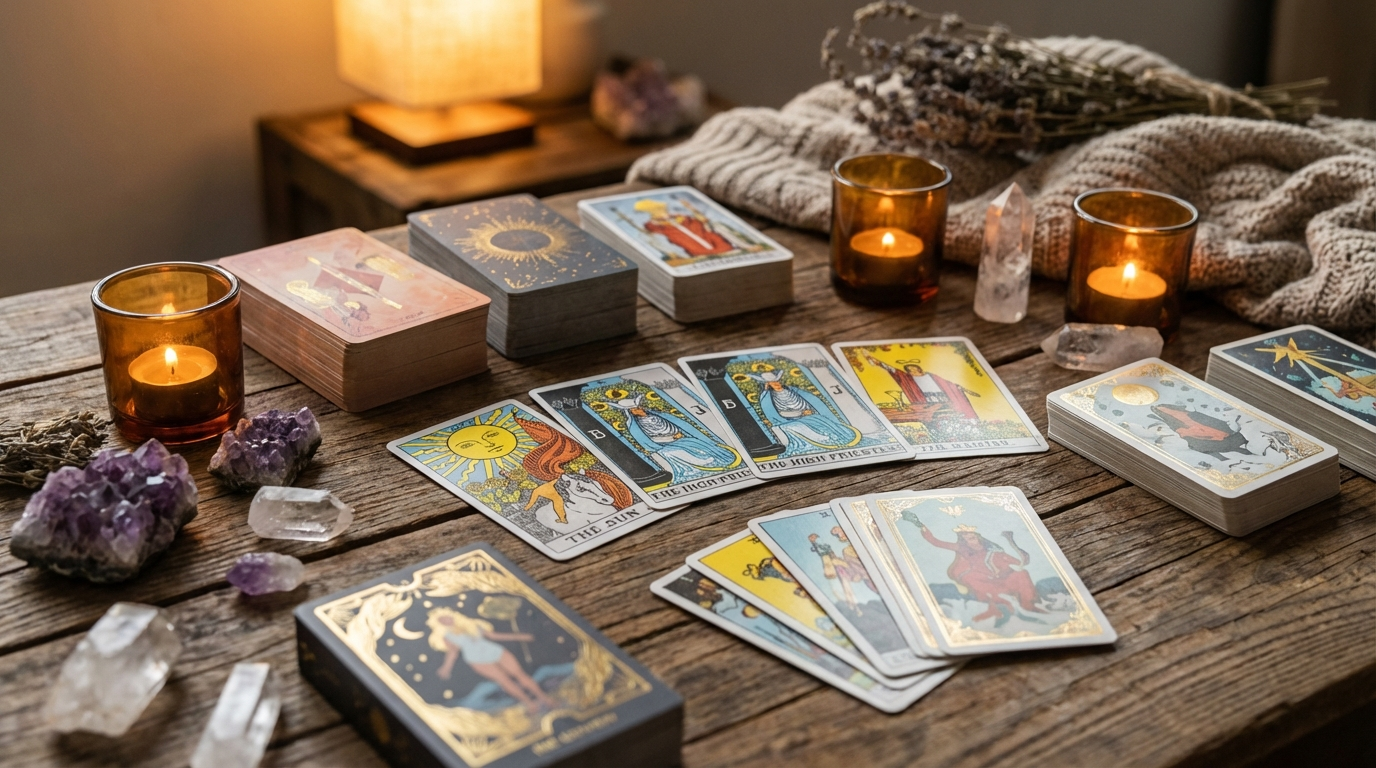
Beyond the classic Rider-Waite-Smith, several other decks have earned their place as wonderful starting points for new readers:
The Modern Witch Tarot by Lisa Sterle reimagines the traditional Rider-Waite imagery with diverse, contemporary characters. If you want a deck that feels fresh and inclusive while still following the RWS system, this is a beautiful choice.
The Light Seer’s Tarot by Chris-Anne is beloved for its dreamy, watercolour-style artwork that feels both modern and deeply spiritual. It’s one of the most popular beginner decks of recent years, and for good reason — the imagery is intuitive and emotionally evocative.
The Everyday Tarot by Brigit Esselmont draws on the RWS system with clean, simplified artwork that makes learning straightforward without sacrificing depth. It comes with an excellent guidebook that’s perfect for beginners.
The Wild Unknown Tarot by Kim Krans uses animal and nature imagery rather than human figures. If you feel a deep connection with the natural world and the energy of spirit animals, this deck may resonate with you powerfully. Just know that it departs from traditional RWS imagery, so you may need to rely more on the guidebook initially.
There is no single ‘correct’ beginner deck. The best deck for you is the one whose imagery makes your heart sing and your intuition stir. Trust that feeling above all else.
The Myth About Receiving Your First Deck
You may have heard the old superstition that your first tarot deck must be given to you as a gift. I want to lovingly put this myth to rest, because I’ve seen too many beautiful souls wait years for a deck that never arrives, missing out on all the guidance and growth the cards could have offered them.
The truth is, buying your own deck is not only perfectly acceptable — it’s actually a powerful act of spiritual intention. When you choose your own deck, you’re making a conscious decision to open yourself to divine guidance. You’re saying to the universe, “I’m ready to listen.” There’s something deeply empowering about that.
Many of the finest tarot readers I’ve known throughout my career — myself included — purchased their very first deck themselves. The cards don’t mind how they found their way to you. What matters is the love, respect, and openness you bring to them once they’re in your hands.
Where to Buy Your Tarot Deck
If you have a local metaphysical shop or spiritual bookstore nearby, I always recommend visiting in person. There’s something irreplaceable about holding different decks in your hands, feeling their weight and energy, and flipping through sample cards. Many shops keep open display decks specifically so customers can connect with the cards before purchasing.
If an in-person visit isn’t possible, reputable online retailers offer most popular decks. Look for listings that include multiple sample card images so you can get a good feel for the artwork. Reading customer reviews can also be helpful — other beginners often share whether a deck is easy to learn with and how the card quality holds up over time.
Wherever you purchase, make sure you’re getting an authentic, officially licensed deck. Unfortunately, there are counterfeit decks circulating online with poor print quality and incorrect card numbering, which will only hinder your learning.
Caring for Your New Deck
Once your deck arrives, you’ll want to treat it with the reverence it deserves. Many readers keep their cards wrapped in silk or stored in a special wooden box. Some place a crystal on top of their deck when it’s not in use — clear quartz for clarity or amethyst for intuition are popular choices.
Before your first reading, I recommend cleansing your cards to clear any residual energy from the manufacturing and shipping process. You can do this through smudging with sage, placing them in moonlight, or simply holding them in your hands and setting your intention for clear, loving guidance.
Over time, your deck will absorb your energy and the readings will become more fluid and personal. This is why many experienced readers are particular about who handles their cards — that energetic bond between reader and deck is genuinely sacred.
What to Do Once Your Deck Arrives
When you first unwrap your deck, resist the urge to immediately do a complex reading. Instead, take time to sit quietly with your cards. Go through each one slowly, looking at the imagery, noticing what draws your eye, what makes you feel peaceful, and what stirs something deeper within you.
A beautiful first exercise is to pull a single card each morning and sit with its energy throughout the day. This simple daily tarot practice builds your relationship with the deck naturally and helps you learn card meanings through lived experience rather than rote memorisation.
As you grow more comfortable, you can begin exploring simple three-card spreads (past, present, future) and gradually work your way up to more complex layouts. And when you encounter cards that confuse you — particularly the court cards or reversed cards — remember that confusion is simply the first step toward understanding.
Start with one card a day. Within a month, you’ll be amazed at how naturally you begin to understand the language of tarot — it’s already inside you, waiting to awaken.
Trusting the Process
I want to leave you with this truth, dear one: there is no wrong choice when it comes to your first tarot deck. The fact that you’re here, reading this, feeling that gentle tug toward the cards — that itself is a sign from the universe that you’re ready.
Your first deck doesn’t need to be your forever deck. Many readers build collections over the years, finding that different decks speak to them in different seasons of their lives. What matters now is simply beginning. Pick up the deck that calls to you, hold it close, and trust that the cards will meet you exactly where you are.
The tarot has been a guiding light in my life for over forty years, and I have never once regretted the moment I first picked up those cards. This could be the beginning of something truly extraordinary for you, and I’m honoured to be part of your journey.
With love and light on your path,
Imelda
Frequently Asked Questions
What is the best tarot deck for absolute beginners?
The Rider-Waite-Smith tarot deck is widely considered the best starting point for absolute beginners. Its fully illustrated Minor Arcana cards make learning intuitive, and the vast majority of tarot resources reference this deck’s imagery. However, any deck with full scenic illustrations that resonates with you personally will serve you beautifully.
Do I need to be psychic to read tarot cards?
Absolutely not. While tarot can certainly help develop your intuitive abilities, you don’t need any special psychic gifts to begin reading. Tarot works through symbolism, storytelling, and reflection. As you practise, you’ll find your intuition naturally strengthening — think of tarot as a tool that helps you access wisdom that’s already within you.
Does my first tarot deck have to be a gift?
No, this is a common myth that has no basis in tarot tradition. Buying your own first deck is a powerful act of spiritual intention and self-empowerment. Many of the world’s most respected tarot readers purchased their first deck themselves. The cards welcome you regardless of how they arrived.
What is the difference between tarot and oracle cards?
Tarot decks follow a specific structure of 78 cards divided into Major Arcana (22 cards) and Minor Arcana (56 cards across four suits). Oracle decks can have any number of cards and follow their own unique themes and systems. Both are valid spiritual tools, but if you want to learn the traditional tarot system, make sure you’re purchasing a tarot deck specifically.
How should I cleanse my new tarot deck?
There are several gentle ways to cleanse your new deck. You can smudge with sage or palo santo, place the cards in moonlight overnight (especially during a full moon), knock gently on the deck three times, or simply hold the cards and set a clear intention for loving, accurate guidance. Choose whichever method feels most natural to you.
How long does it take to learn tarot?
Tarot is a lifelong journey rather than a destination. You can start doing meaningful readings within a few weeks of daily practice, but the depth of your understanding will continue to grow for years. Most beginners find that after about three months of consistent daily card pulls, they feel comfortable with basic readings. Be patient with yourself and enjoy the process of discovery.
Can I use tarot cards for myself or only for reading others?
You can absolutely read tarot for yourself — in fact, self-readings are one of the most powerful ways to develop your skills and deepen your self-awareness. Many experienced readers, including myself, pull cards for personal guidance every single day. Reading for yourself helps you build confidence before reading for others.
Should I be worried about pulling scary cards like Death or The Tower?
Not at all. Cards like Death and The Tower often carry the most profound and positive messages. Death represents transformation and beautiful new beginnings, not literal death. The Tower represents breakthrough moments that clear away what no longer serves you. Every card in the tarot carries wisdom and guidance — there are no truly ‘bad’ cards, only honest ones.
About the author


What do you think?
Lets login and you can leave your thoughts