



- Why a Daily Practice Changes Everything
- What You Need to Get Started
- Choosing the Right Deck
- Creating Your Sacred Space
- The Daily Card Pull
- The Power of Tarot Journaling
- Adding a Weekly Three-Card Spread
- Common Mistakes to Avoid
- Deepening Your Practice Over Time
- What to Do When You Feel Stuck
- Frequently Asked Questions
Have you ever wished you could tap into your intuition as easily as checking the weather? I’ve been reading tarot for over four decades now, and I can tell you with absolute certainty that the most transformative thing I ever did wasn’t learning a complicated spread or memorising every card meaning — it was committing to a simple daily tarot practice.
A daily tarot practice is exactly what it sounds like: pulling one card each day, sitting with its message, and letting it guide your awareness. It’s beautifully simple, deeply powerful, and something anyone can begin today — no prior experience required. Whether you’re completely new to tarot or you’ve been curious for years but never quite started, this guide will walk you through everything you need to build a practice that genuinely changes how you move through your life.
Why a Daily Practice Changes Everything
There’s a reason I recommend a daily practice to everyone who asks me about tarot, and it isn’t because I think you need to become a professional reader. It’s because consistency creates a channel between your conscious mind and your deeper knowing — that quiet, wise voice that often gets drowned out by the noise of everyday life.
When you pull a single card each morning, you’re not predicting the future. You’re opening a conversation with your intuition. Over time — and I’m talking weeks, not years — you’ll begin noticing patterns. You’ll start understanding the cards not from a textbook, but from lived experience. That Eight of Cups won’t just mean “walking away” in the abstract; it’ll remind you of that Tuesday when you finally set a boundary you’d been avoiding.
A daily tarot practice isn’t about predicting the future — it’s about building a relationship with your intuition that grows stronger with every card you pull.
I’ve watched hundreds of students transform through this simple practice. People who started out feeling completely disconnected from their intuition were, within a few months, making decisions with a confidence and clarity they didn’t know they possessed. The cards didn’t give them that — the daily practice of listening did.
What You Need to Get Started
The beauty of a daily tarot practice is its simplicity. You don’t need a dedicated altar room or thousands of pounds worth of crystals. Here’s what you genuinely need:
- A tarot deck — any standard 78-card deck will do
- A journal or notebook — dedicated to your tarot practice
- Five minutes — that’s honestly all it takes
- An open heart — willingness to listen to what comes through
That’s it. Everything else — the candles, the crystals, the silk wrapping cloths — those are lovely additions that may come later, but they are not essential. I started my own practice with nothing but a second-hand Rider-Waite deck and a spiral notebook, and that was more than enough.
Choosing the Right Deck
If you don’t already have a deck, I’d recommend starting with the classic Rider-Waite-Smith tarot. I know that might sound old-fashioned, but there’s a reason it’s endured since 1909 — the imagery is rich, symbolic, and deeply intuitive. Most tarot books and guides reference this deck, which makes learning much smoother.
That said, the most important thing is that your deck speaks to you. If another deck catches your eye and you feel drawn to its artwork, trust that pull. Your intuition is already working before you’ve even started reading. Handle a few decks if you can, and notice which one feels right in your hands. The connection between reader and deck matters more than any recommendation I can give you.
Creating Your Sacred Space
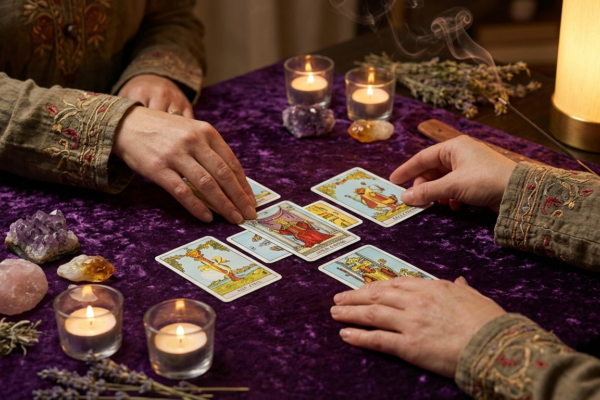
You don’t need an entire room — a corner of your kitchen table works perfectly. What matters is creating a moment of intention, a signal to your mind and spirit that you’re shifting from the ordinary into the sacred.
Some simple ways to mark this transition:
- Light a candle before you begin
- Take three deep breaths with your eyes closed
- Hold your deck against your heart for a moment
- Say a brief intention, even silently: “Show me what I need to know today”
These small rituals might seem insignificant, but they’re actually training your brain to enter a receptive state. Over time, just the act of lighting that candle will begin to shift your awareness. It becomes a doorway between your everyday mind and your intuitive self.
The Daily Card Pull
This is the heart of your practice, and it’s wonderfully simple.
The Morning Pull
Each morning, shuffle your deck while thinking about the day ahead. Don’t ask a specific question — simply hold an open intention like “What energy should I be aware of today?” or “What does today want me to know?” When you feel ready, pull a single card.
Look at the image before you reach for any guidebook. What do you notice first? What colours stand out? What is the figure doing, and how does that make you feel? These initial impressions are your intuition speaking, and they’re often more accurate than any textbook definition.
After you’ve sat with the image for a minute or two, you can look up the traditional meaning if you like. But always honour your first impression — it’s the voice of your inner knowing.

The Evening Reflection
This is the step most people skip, and it’s the one that accelerates your learning more than anything else. At the end of your day, return to the card you pulled that morning. How did its energy show up in your day? Did the Three of Wands appear on a day when you found yourself looking ahead and planning? Did the Queen of Cups show up when you needed to lead with compassion?
This reflection is where the magic truly happens. You’re building a personal, experiential understanding of each card that no book can give you. After a few months of this, you’ll know the cards not as abstract concepts but as living energies you’ve danced with.
The evening reflection is the secret ingredient most beginners miss. Connecting your morning card to your actual lived experience is what transforms tarot from a hobby into genuine wisdom.
The Power of Tarot Journaling
Your tarot journal is where your practice truly comes alive. Each day, write down:
- The date and the card you pulled
- Your first impression — what you noticed and felt
- The traditional meaning (briefly)
- Your evening reflection — how the card showed up in your day
After a month, you’ll have thirty entries. Look back through them. Which cards appeared most frequently? Which ones surprised you? You’ll start seeing your own patterns and themes emerge — recurring lessons, growing edges, areas of strength you didn’t recognise.
I still have my very first tarot journal from the early 1980s, and reading through it now is like holding a conversation with my younger self. Those daily entries became a map of my spiritual growth, and yours will too.
Adding a Weekly Three-Card Spread
Once your daily single-card practice feels natural — usually after about a month — you might want to add a weekly spread. Every Sunday evening or Monday morning, pull three cards for the week ahead. You can use a simple past-present-future layout, or my personal favourite: challenge, guidance, and outcome.
This weekly spread gives you a broader perspective while your daily cards provide the close-up detail. Together, they create a rich, layered understanding of the energies moving through your life. If you’d like to explore more spread options, I’ve put together a guide to powerful tarot spreads for self-discovery that pairs beautifully with a daily practice.
Common Mistakes to Avoid
After decades of teaching tarot, I’ve seen the same stumbling blocks come up again and again. Here’s what to watch out for:
Trying to memorise all 78 cards at once. This is the fastest route to burnout. Let the cards reveal themselves to you one day at a time. Your daily practice will teach you the meanings far more effectively than flashcards ever could.
Pulling multiple cards when you don’t like the first one. I know it’s tempting, darling, but that first card appeared for a reason. Pulling again until you get The Sun or the Ten of Cups isn’t a reading — it’s avoidance. The uncomfortable cards often carry the most important messages.
Skipping days and then giving up entirely. You will miss days. Life happens. The key is to simply pick up your deck the next morning without guilt or drama. A practice with gaps is still infinitely more valuable than no practice at all.
Relying too heavily on guidebooks. Reference books are wonderful tools, but if you’re reading the book interpretation before even looking at the card, you’re bypassing the very intuition you’re trying to develop. Image first, book second — always.
Missing a day doesn’t break your practice — giving up does. Simply pick up your deck the next morning and begin again. Consistency over perfection, always.
Deepening Your Practice Over Time
As weeks turn into months, your daily practice will naturally evolve. Here are some beautiful ways to deepen your connection:
Study one suit per month. Spend four months focused on each suit — Cups, Wands, Swords, and Pentacles. Notice when cards from your “study suit” appear in your daily pulls and pay extra attention to their nuances.
Learn the court cards as people in your life. The Kings, Queens, Knights, and Pages often represent actual people or aspects of personality. Start matching court cards to people you know — it makes them unforgettable.
Meditate with your card. After pulling your daily card, spend five minutes in quiet meditation, holding the card’s image in your mind. Let it speak to you in ways that go beyond words. Some of my most profound insights have come through this simple practice.
Connect tarot to the moon cycle. Pull a card at each new and full moon to track the larger rhythmic energies moving through your life. Over time, you’ll notice how these lunar readings weave together with your daily pulls in surprising ways.
What to Do When You Feel Stuck
Every tarot reader hits a plateau — a stretch of days when the cards feel flat, when your journal entries seem repetitive, when you wonder if this is really working at all. I want you to know: this is completely normal, and it’s actually a sign of growth.
When you feel stuck, try changing one small thing. Shuffle differently. Pull from the bottom of the deck instead of the top. Read with your non-dominant hand. Use a different deck for a week. These small shifts can break the pattern and reignite your connection.
You might also try a deeper exploration of tarot fundamentals — sometimes going back to basics with fresh eyes reveals insights you missed the first time around.
And if all else fails, simply sit with your deck in your hands and breathe. No shuffling, no pulling, no pressure. Just you and the cards, sharing space. Sometimes the most powerful thing you can do is stop trying so hard and simply be present.
Starting a daily tarot practice is one of the most loving things you can do for your spiritual growth. It doesn’t require hours of study or any special abilities — just a willingness to show up each morning, pull a card, and listen. The cards will teach you everything you need to know, one day at a time.
Trust the process, trust the cards, and most of all, trust yourself. Your intuition has been waiting for this moment, and I’m so excited for you to begin this beautiful journey.
Frequently Asked Questions
How many tarot cards should I pull each day?
For a daily practice, one card is perfect. It gives you enough to reflect on without overwhelming you. As you grow more comfortable, you might add a weekly three-card spread, but your daily single card should remain the foundation of your practice.
Do I need to be psychic to read tarot cards?
Not at all, darling. Tarot is a tool for developing and strengthening your intuition — something every single person possesses. You don’t need special gifts to start. The cards meet you exactly where you are and help you access the wisdom that already lives within you.
What is the best time of day for a tarot reading?
Morning is wonderful because it sets an intention for your day, but there’s no wrong time. Some people prefer evening readings to reflect on the day that’s passed. The best time is whatever you can commit to consistently. Your practice thrives on regularity, not perfection.
How long does a daily tarot practice take?
As little as five minutes. Pull a card, sit with the image for a moment, jot a few notes in your journal, and you’re done. As your practice deepens, you may naturally want to spend more time — ten to fifteen minutes — but even two minutes of genuine connection with a card is valuable.
Should I use reversed cards in my daily practice?
When you’re just starting out, I’d suggest working with upright cards only. This lets you build a solid foundation with the core meanings first. After a month or two, you can begin incorporating reversed cards to add nuance and depth to your readings.
Do I need to cleanse my tarot deck before each reading?
Not necessarily before every reading, but regular cleansing keeps the energy clear. A simple knock on the deck or a quick shuffle can reset the energy for daily pulls. For deeper cleansing methods, I’ve written a complete guide on how to cleanse your tarot cards.
What if I keep pulling the same card repeatedly?
Pay attention — the universe is trying to tell you something! When a card keeps appearing, it means there’s a lesson or message you haven’t fully received yet. Spend extra time journaling about that card. What aspects of its meaning might you be overlooking or resisting?
Can I do tarot readings for other people as a beginner?
I’d recommend reading for yourself for at least three to six months before reading for others. This gives you time to build confidence in your interpretations and develop your unique reading style. When you do start reading for others, begin with close friends or family who will be supportive and patient.
About the author




What do you think?
Lets login and you can leave your thoughts